|
Modernisme, is a timeless style that was developed by artists and architects over the turn of the twentieth century. The French called it Modern Style. The British called it Art Nouveau. The Italians called it Floreale. The Germans called it Judendstil. In the English language, it even inspired the word "gaudy." That is because Antoni Gaudí is one of the forefathers of this innovative, avant-guarde and often funky movement in art. Antoni Gaudí spent most of his time and energy in the city of Barcelona in the Catalan region of Spain. His colorful and still original masterpieces can be seen all over the city.
Antoni Gaudí was 34 years old in 1886 when he was commissioned by the wealthy Eusebi Güell to design his residence. There was no limit on the budget, and therefore Gaudí used the best stone, wrought iron and wood in building the Palau Güell mansion. Gaudí used these materials, as well as glass and concrete to create everything from doors to floors and to chimneys, such as those seen here on the top of the Palau Güell mansion.
The Mansana de la Discorde is a stretch of road that houses three of the finest architectural examples of Modernisme in Catalan. Our favorite building was, of course, that of Antoni Gaudí. Named Casa Batilló, after the owner, Gaudí said that he was creating a vision of paradise.
The roof is also open for exploration and examination of funky chimneys, a colorful inner courtyard and great views. People still rent apartments inside of the Pedrera for a small fortune.
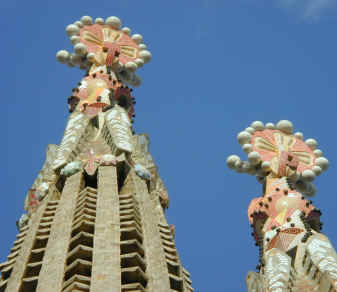
The Temple de la Sagrada Familia was not only a job for Antoni Gaudí. It was a passionate symbol of his love for architecture, nature, free style and God. Gaudí built his workshop and bedroom inside of the church so that he could be with his project all of the time. Unfortunately, Antoni Gaudí passed away in 1926 after having only completed this facade and building up one spire. Not to worry, however. Gaudí left behind designs and plans so that the work could be carried out even after his death.
Construction is being carried out even to this day. Will it ever be completed? We hope so--perhaps in our lifetime.
And Gaudí's colorful and creative style is to be seen everywhere from the arched doorways to the pink flowered tops of the one hundred meter spires. Antoni Gaudí himself is buried in a crypt below the church.
And now come with us to the Basque country in northern Spain as we visit the Forty-eighth Annual Film Festival in San Sebastian. |
|
2 Go Maps / 2 Go Actual Itinerary / 2 Go Photos / 2 Go Home Page
PLEASE E-MAIL US. . . WE WOULD LOVE 2 HEAR FROM YOU!
©1999-2001 Kelly and Rich Willis. All rights reserved. |


 The
Casa Milá, also known as the "Pedrera" ("stone"), is hands
down the most famous building of Antoni Gaudí. Completed in 1912, this
was his last apartment building. The public did not appreciate the
innovative facade until years later. Now, the Pedrera is heralded as an
architectural sculpture. The public is invited to visit some of apartments
that have been preserved to look as they did during their early years.
While browsing the stylish pads, we are reminded of the inventions and that
sparked this creative movement in art: the telephone, the radio, the
automobile.
The
Casa Milá, also known as the "Pedrera" ("stone"), is hands
down the most famous building of Antoni Gaudí. Completed in 1912, this
was his last apartment building. The public did not appreciate the
innovative facade until years later. Now, the Pedrera is heralded as an
architectural sculpture. The public is invited to visit some of apartments
that have been preserved to look as they did during their early years.
While browsing the stylish pads, we are reminded of the inventions and that
sparked this creative movement in art: the telephone, the radio, the
automobile.