|
The Story of Pompeii and HerculaneumOn August 24, 79 AD, Mt. Vesuvius began to roar. The Roman inhabitants in the nearby towns of Pompeii and Herculaneum did not know what to think as they were not aware that the beautiful and lush mountain which they adored was actually a volcano. The eerie roar and the raining ash continued for eleven hours. At midnight, the top of Mt. Vesuvius collapsed, sending down a glowing avalanche of superheated gases, rocks and lapilli (burning fragments of pumice stone). This first avalanche buried the city of Herculaneum and its citizens within a very short time. Throughout the night, ash and pumice continued to rain over Pompeii at a rate of six inches per hour. Finally, the next morning, a fourth avalanche sent a surge of gases, rocks and lapilli towards Pompeii and buried the ancient Roman resort town and its residents as well. While many wrote about the tragedy immediately after it occurred, the cities of Pompeii and Herculaneum remained a mystery to the world until a well digger stumbled across a part of Herculaneum during the eighteenth century. The pumice ash preserved the cities and many of the frescoes, mosaics and bones of those who were not able to escape the volcano's wrath. While the devastating eruption was a great tragedy, at least it provides the world with a remarkably well-preserved view of ancient Roman life during those times.
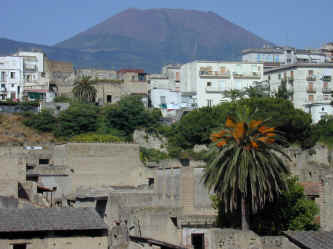
The photos above depict the excavated city of Herculaneum. In the background, we can see Mt. Vesuvius. Notice the top has lost a substantial amount of its cone. This is from the 79 A.D. eruption. Although this mischievous volcano has erupted eighty times since then, life in modern Herculaneum (actually, the modern city is called Ercolano) and Pompeii continues. Mt. Vesuvius last exploded in 1944 and many predict she is due for another eruption. Let's hope not.
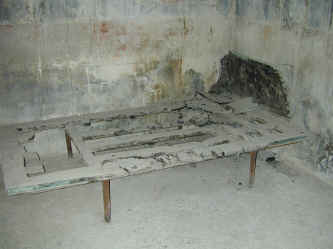
A bed found in one of the homes of Herculaneum.
A mosaic tile floor found in a well to do home in Herculaneum. Notice the ripple effect. As novice archeologists, we predict that this was caused by the forces of the volcano along with earthquakes that have occurred over the years since 79 A.D. The amazing thing is that the tile is still in place and very well preserved.
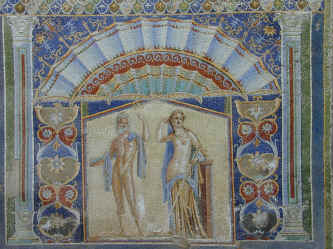
This wall mosaic belonged to either a temple or a home of a millionaire. Again, it is amazing that this colorful work of art has survived the past 1900 years and still looks incredibly bright and vivid.
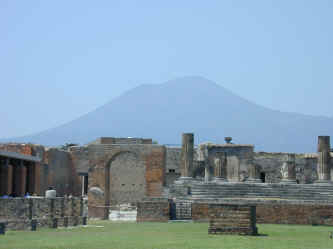
The city of Pompeii was founded centuries before the tragic eruption and served as an export center for wine. Pompeii was also a resort town for wealthy Romans. This is evidenced by the impressive temples, amphitheaters, shops, luxurious homes and works of art found throughout the city. During its prime, Pompeii had a population of 10,000-20,000 and was home to Greek, Germanic, Latin and Hebrew speaking cultures. Pompeii is very large. It took us several hours to walk through the impressive city. To the right is a temple with the culprit, Vesuvius, in the background.
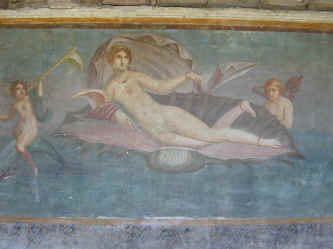
A fresco of the Goddess, Venus, found in one of the luxurious homes of Pompeii.
Many wonder why so many died in Pompeii if they had so much time before the volcano's fourth eruption. However, we must remind ourselves that they did not know that Mt. Vesuvius was a volcano. Soon after the volcano started to roar the day before the eruption, ash began to rain upon them and many retreated to the safety of their homes. Others tried to flee. While some of them may have made it to safety, there is evidence to show that so many did not. Below is a plaster cast of the bones of a man who is covering his eyes and nose just before meeting his fate.
As written by one who observed the tragedy from a nearby town, "many besought the aid of gods, but still more imagined there were no gods left and that the universe was plunged into eternal darkness evermore."
After this moving experience, we
vacationed with the elite Italians on the Amalfi Coast. |
|
2 Go Maps / 2 Go Actual Itinerary / 2 Go Photos / 2 Go Home Page
PLEASE E-MAIL US. . . WE WOULD LOVE 2 HEAR FROM YOU!
©1999-2001 Kelly and Rich Willis. All rights reserved. |