|
Isla Isabela, which is shaped like a sea horse, is the largest and the youngest of the Galápagos Islands. Our first destination on Isabela was Punto Moreno where we were first introduced to the landscape of volcanic rock that covers many of the islands. To us, it looked like miles and miles of black pavement that had cracked, been uplifted, been twisted, and otherwise mangled. Amidst this inhospitable volcanic rock, certain species of cacti flourished and occasionally we would happen upon lagoons visited by flamingos, birds, and other wildlife. After a morning's tour of Punto Moreno, we returned to the boat and headed for what was to become one of the most amazing experiences of our lives. Namely, we headed to a small cove found by our captain, Pepe, and the Samba's owner, many years ago and named by them "Caleta Pepe". What is extraordinary about Caleta Pepe, which is a cove formed of volcanic rock, is that it is inhabited by dozens of endangered sea turtles. At Caleta Pepe, we had the once in a lifetime opportunity to snorkel, in close quarters, among dozens of these large graceful creatures. While we were careful not to touch them, at times the turtles approached us so closely that we were worried they would touch us. After the exhilaration of our afternoon snorkel, we set sail once more to a more northern point along Isla Isabela's shoreline and visited the Mariellas Island where we saw penguins along with marine iguanas and boobies. We also took our panga into the jungle where we saw mangrove trees and many more sea turtles, but no monkeys. The following day we visited Isabela's Bahia Urbina which was formed when a volcanic thrust lifted this coral reef from out of the sea. One minute it was a large coral reef in the sea, the next minute it was part of the island. There, we saw giant land tortoises in the wild together with land iguanas and marine iguanas.
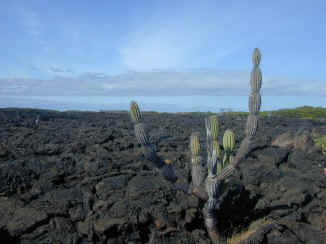
When we landed on Isabela, we felt more like we had landed on Mars. Black and brown lava rock was everywhere, interspersed with occasional cacti and lagoons.
Many bright pink flamingos live on the Islands. While Kelly dreamed of seeing lagoons full, here are the two we saw.
Kelly stands among the lava rock that spewed from the Sierra Negra volcano behind her over 700,000 years ago. Many of the volcanoes on the Gálapagos Islands, including this one, are still very active, the most recent eruption being in 1998.
This sea lion basks in the sun after a morning swim.
A cactus on Isla Isabela with small bulbous fruits. We tasted the fruit which looked and tasted somewhat like Kiwi fruit.
The flightless cormorant of the Galápagos Islands is the only cormorant in the world that can no longer fly. This bird species is slowly, over time, losing its wings, and many speculate it will eventually develop flippers, like the penguin, to help it catch fish in the waters. Darwin's theory of evolution is at work. This cormorant flaps his sorry little wings which, as you can see, are insufficient to lift his large body into the air.
The graceful, and endangered, sea turtle swims below the water. Swimming with the sea turtles is an experience we will never forget. It was like swimming in a small aquarium filled with sea turtles.
Kelly relaxes on the top deck of the Samba. Behind her, you may notice the change in color of the water behind her from brilliant blue to aqua green. That is not a shadow or a change in the depth of the water, rather, it is a sudden change in the temperature of the ocean which causes more vegetation to grow in that area. It was amazing to see such a clear line in the water that extended as far as the eye could see.
We constantly had companions as we sailed all around the Galápagos Islands. Among these visitors were flocks of frigates. The frigate is the best long distance flying bird in the world as it effortlessly can fly seemingly endlessly.
The Galàpagos penguins. Penguins at the Ecuator? You betcha! These penguins traveled to these Islands from Antartica many many years ago. While all of the El Niños that do, occasionally, plague the Galàpagos often reduce significantly the population of penguins (because El Niño causes the Pacific Ocean to become too warm), they are still hanging on.
Here, a penguin waddles after an iguana. Nowhere else in the world, other than the Galàpagos, would you find a penguin playing with an iguana.
As we enter the jungle in our panga, we see many large, lush mangrove trees. While everywhere else the mangrove only reaches bush status, in the Galàpagos the mangroves manage to grow to be large trees that maintain their foliage year round.
On our panga after our jungle visit as we head back to the Samba. The derelict behind us is Jan.
The next morning we visited Bahia Urbina and saw our first land iguanas. While this picture does not do the color of the land iguana justice, its skin is a yellowish orange very distinct from the much darker skin of their relatives, the marine iguana. The reason for this difference in color is evolutionary in nature. Marine iguanas must capture heat from the sun to regulate their body temperature as they spend so much time in the relatively cold waters of the Pacific. Hence they are black. In contrast, since land iguanas spend their time on the much hotter land, they need to repel, not attract, the sun's rays. The land iguana's tail is also rounded, while the marine iguana's tail is flat so as to better allow it to propel itself through the water.
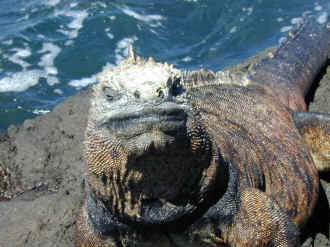
Known to our guide affectionately as Andres, this marine iguana was enormous. Roughly four feet in length and as fat around as a watermelon, Andres aint gonna win no beauty contest!
The symbol of the Galàpagos Islands, a wild giant land tortoise rests in the shade at Bahia Urbina.
Next stop, Isla Fernandina. |
|
2 Go Maps / 2 Go Actual Itinerary / 2 Go Photos / 2 Go Home Page
PLEASE E-MAIL US. . . WE WOULD LOVE 2 HEAR FROM YOU!
©1999-2001 Kelly and Rich Willis. All rights reserved. |