

|
The Polish city of Kraków has lived a charmed life. For centuries, Kraków was the country's capital and seat of Polish royalty. During this golden age, she was adorned with royal palaces, great cathedrals and a grand town square. Kraków also became home to the country's first university over 600 years ago. The charmed city has also managed to avoid major destruction from the many battles and wars that Poland has endured, including the bloodiest of all, WWII. Kraków also managed to fare well during the Cold War and is adjusting to capitalism and tourism at a rapid pace. The old town continues to charm both visitors and locals alike.
The center of Stare Miasto, or Old Town, is the best place to begin exploring Kraków. The large town square (the largest medieval square in all of Europe)is bordered by the two towers of St. Mary's Church (left), rows of multi-colored town houses (below left), the bell tower of St. Wojciech's Church (below right) and Cloth Hall (featured further below). It is also the stage for many cafes and summer musical entertainment. The two towers of St. Mary's Church was built by two brothers incidentally. One brother built his tower at a very rapid pace, while the other worked slowly and steadily, paying attention to fine details. When the hasty brother could see that the tower being constructed by his brother was far more beautiful, he became very jealous and murdered him. True story.
Pope John Paul II was archbishop in this cathedral in the years before he was chosen to lead the Catholic Church--before picking a cool Pope name, his friends new him as plain old Karol Wojtyla.
Like its neighbor, Budapest, Krakow is slowly adjusting to the growing number of tourists pouring into the city gate. While there are many hotels, there do not seem to be any that fall into our niche--cheap, but clean. After a day of being turned away from the mid-range hotels ("Fully booked" they all managed to say), we were forced to stay in what we affectionately dubbed, The Flop House. While they have named themselves The Hotel Piasta during the summer, this concrete abomination is a student dorm during the school year. Do not get us wrong, we both lived in student dorms in our younger years. However, this place was more like "Prisoner Cell Block H" than the "West Wilson Resident Hall". At $19 per night, however, it did the trick.
A fun and worthwhile excursion while in Kraków is a trip to the 1000 year old Wieliczka salt mine. From the Earth's surface we climbed down 400 feet into a land made almost completely of salt.
Mining is very dangerous work. Therefore, the miners took great care in sculpting ornate chapels completely out of salt where they could pray for their safety. The most impressive chapel is the Chapel of the Blessed Kinga which is dedicated to their patron Saint of Salt (long story). This giant chapel is made completely of salt, from the salt tiles on the floor to the salt chandeliers hanging from the salt ceiling. Here we see that the miners did not forget about their home town boy, Pope John Paul II. And while he may not look like salt, trust us, he is.
Oscar Schindler's factory was located in Kazmierz . It is now an electrical works factory. Shown here is an apartment building in Kazmierz. While most of the apartment buildings, stores and synagogues of Kazimierz survived the madness of WWII, the number of Jewish people living in here has declined to only 100.
Near the lovely city of Krakow lies the haunting concentration camps of Auschwitz.
|
|
2 Go Maps / 2 Go Actual Itinerary / 2 Go Photos / 2 Go Home Page
PLEASE E-MAIL US. . . WE WOULD LOVE 2 HEAR FROM YOU!
©1999-2001 Kelly and Rich Willis. All rights reserved. |


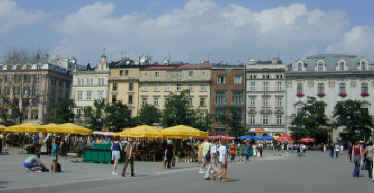
 Cloth
Hall was originally home to clothing merchants, and sits smack dab in the middle
of Krakow's town square.. It is now home to souvenir merchants who are
raking it in with the increasing numbers of tourists that come pouring in every
day. In front of Cloth Hall is the statute of the Polish poet, Adam
Mickiewicz, which serves as a meeting place for many (including many of Krakow's
heavily pierced, tattooed, and troubled youth).
Cloth
Hall was originally home to clothing merchants, and sits smack dab in the middle
of Krakow's town square.. It is now home to souvenir merchants who are
raking it in with the increasing numbers of tourists that come pouring in every
day. In front of Cloth Hall is the statute of the Polish poet, Adam
Mickiewicz, which serves as a meeting place for many (including many of Krakow's
heavily pierced, tattooed, and troubled youth).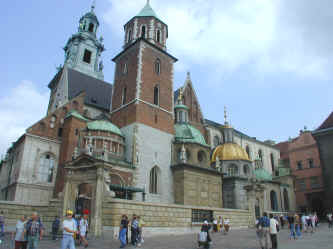 Wawel
Castle served as the seat of Polish royalty for many centuries. One of
most beautiful pieces of architecture on the castle grounds is the Wawel
Cathedral. We rather liked the eclectic style of the cathedral's exterior.
It was in the Wawel Cathedral that the Kings were enthroned and also where they
were entombed.
Wawel
Castle served as the seat of Polish royalty for many centuries. One of
most beautiful pieces of architecture on the castle grounds is the Wawel
Cathedral. We rather liked the eclectic style of the cathedral's exterior.
It was in the Wawel Cathedral that the Kings were enthroned and also where they
were entombed. 


 Kazimierz
is the old Jewish quarter of Kraków. On the eve of WWII more than 50,000
Jewish people lived here. At 4:45 a.m. on September 1, 1939, Nazi Germany
invaded Poland and WWII began. Not long thereafter, the Jews of Kazmierz
were relocated to the Podgorze ghetto nearby (an event depicted at the beginning
of the movie, Schindler's List). The conditions in the ghetto were
so terrible that many died of starvation and disease. By 1943, all those
that had survived the ghetto had been deported to concentration camps, including
the nearby Auschwitz and Birkenau (Auschwitz II).
Kazimierz
is the old Jewish quarter of Kraków. On the eve of WWII more than 50,000
Jewish people lived here. At 4:45 a.m. on September 1, 1939, Nazi Germany
invaded Poland and WWII began. Not long thereafter, the Jews of Kazmierz
were relocated to the Podgorze ghetto nearby (an event depicted at the beginning
of the movie, Schindler's List). The conditions in the ghetto were
so terrible that many died of starvation and disease. By 1943, all those
that had survived the ghetto had been deported to concentration camps, including
the nearby Auschwitz and Birkenau (Auschwitz II). 