|
No visit to India would seem complete without a visit to the Taj Mahal, the de facto symbol of India. So we traveled to Agra, where the Taj and several other interesting sights can be seen.
Our first sight was the Itimad-ud-daulah, more commonly referred to as the "Baby Taj" given the similarity of many of the elements of construction and design with its more famous cousin, construction on which began only several years later. The Baby Taj is the first Mughal structure to be built entirely of white marble. As with the Taj Mahal, the Baby Taj is also, first and foremost, a tomb.
Some of the fine, marble detail that can be seen at the Baby Taj. This is an example of pietra dura, or marble inlay work, where white marble is inlaid with marble of different colors to form patterns and designs. Both the Baby Taj and the Taj Mahal share this beautiful design feature.
Another of Agra's principal sights is the imposing, and impressive, Agra Fort. Built of red sandstone and towering over a river below, the Amar Singh Gate appears in the photo to the left. Construction was begun on the Agra Fort by Emperor Akbar in 1565.
The Agra Fort enjoys splendid views of the Taj Mahal, which can be seen in the distance behind Rich. It also has an interesting history, as it was in this fort where Shah Jahan, who had the Taj Mahal built as a tribute/tomb for his wife who died during childbirth, was imprisoned for 7 years by none other than his son who had him deposed. In the Octagonal Tower, Shah Jahan passed the last years of his life before death, looking across the river and fields to the Taj Mahal.
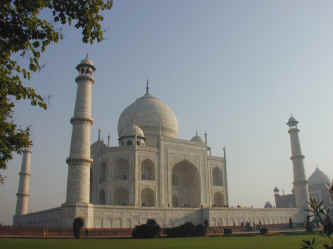
Described as the most impressive monument ever built for love, the Taj Mahal was built by Emporer Shah Jahn in loving memory of his wife who, in 1631, died during childbirth. This mausoleum houses the tomb of his wife as well as his own. Known for its perfect symmetry, the Taj Mahal really is a breathtaking sight.
The Taj Mahal at sunrise.
A rear corner of the Taj Mahal.
Some of the exquisite marble detail so characteristic of the Taj Mahal.
A mosque stands to the west of the Taj Mahal as Shah Jahan, who had the Taj Mahal built, was Muslim. An identical building stands to the east of the Taj Mahal, preserving the all-important precise symmetry for which the Taj is famous. Since it does not, however, face the east, it cannot be used as a Mosque.
The Taj is an amazing sight from any angle and from any distance. An absolutely massive structure, the detail in its construction is superb. It is definitely a well-known icon that does not disappoint the visitor. We trust that President Bill Clinton felt similarly during his visit, which was scheduled within a week of our own during his 5 day trip to India. All of Agra was very excited to be hosting the President, and around the clock efforts were underway to freshen up the city and put its best face forward.
|
|
2 Go Maps / 2 Go Actual Itinerary / 2 Go Photos / 2 Go Home Page
PLEASE E-MAIL US. . . WE WOULD LOVE 2 HEAR FROM YOU!
©1999-2001 Kelly and Rich Willis. All rights reserved. |